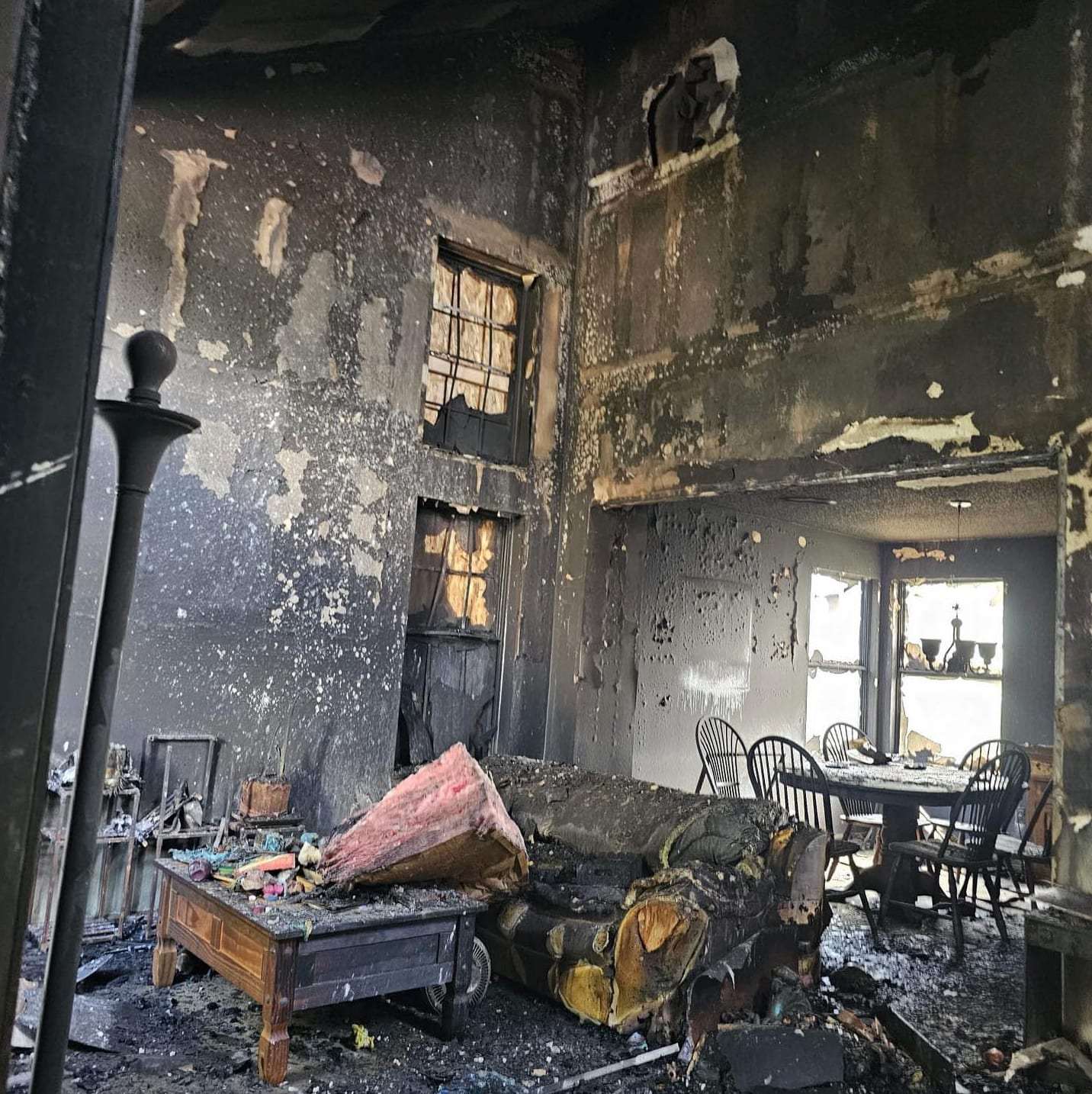
Fire-gutted living room with charred furniture. Illustrative image of the process; it does not document a job done for this site.
Why temporary protection fails here
Tarps fail first at the edges. Wind gets under a loose corner, lifts the tarp like a sail and either tears it or pulls the fasteners through. Strong winter and spring winds along the Front Range can do that in a single night. A tarp that is wrapped over the ridge and battened down with wood strips along its edges holds far better than one held with a few nails through grommets.
Heavy spring snow is the second problem. Wet snow piles up on a sagging tarp over a burned-out section and can pond water into the attic as it melts, or add load to framing that the fire has already weakened. Hail can puncture lighter tarps and shatter the plastic sheeting sometimes used over windows.
Board-up has its own weak points. Plywood screwed into charred or water-softened framing can work loose, and gaps at the top of a panel let snow drift in. Interior bracing or through-bolting is sometimes used on larger openings.
Weather and what to watch for
| Weather event | Common failure | What to check afterward |
|---|---|---|
| High wind | Tarp edges lifting, torn grommets, loose boards | Every edge and corner of the tarp; fasteners on plywood |
| Heavy wet snow | Sagging tarps, ponding, meltwater leaks | Low spots on the tarp and ceilings below for new stains |
| Hail | Punctured tarps and plastic sheeting | Holes in the tarp and wet insulation in the attic |
| Freeze and thaw | Ice under tarp edges, gaps opening at boards | Seals at the top edges of window boards |
| Summer heat | UV breakdown of tarps left for months | Brittle, faded areas that will tear in the next wind |
A storm-check routine for the owner or contractor
- Agree in writing who checks the house after each storm, and how soon
- Look at the roof from the ground with binoculars rather than climbing
- Walk inside to look for fresh drips, stains or snow on the floor
- Photograph any failure before it is repaired, with the date
- Ask whether re-tarping after a storm is included or billed separately
- Report new water damage to your insurer as part of the open claim
Common questions
Is damage from a failed tarp part of my fire claim?
Often it is handled as part of the same loss, but a failure caused by poor installation may also be a question for the contractor who installed it. Document it right away and report it to both.
Should the board-up be removed for showings or inspections?
Only by the contractor who installed it or with their agreement, and it should go back up the same day. Loose boards are an invitation for weather and trespassers.
General information for Centennial, not a quote or professional advice. In an emergency, call 911.